What is Build, Bin, Boost?
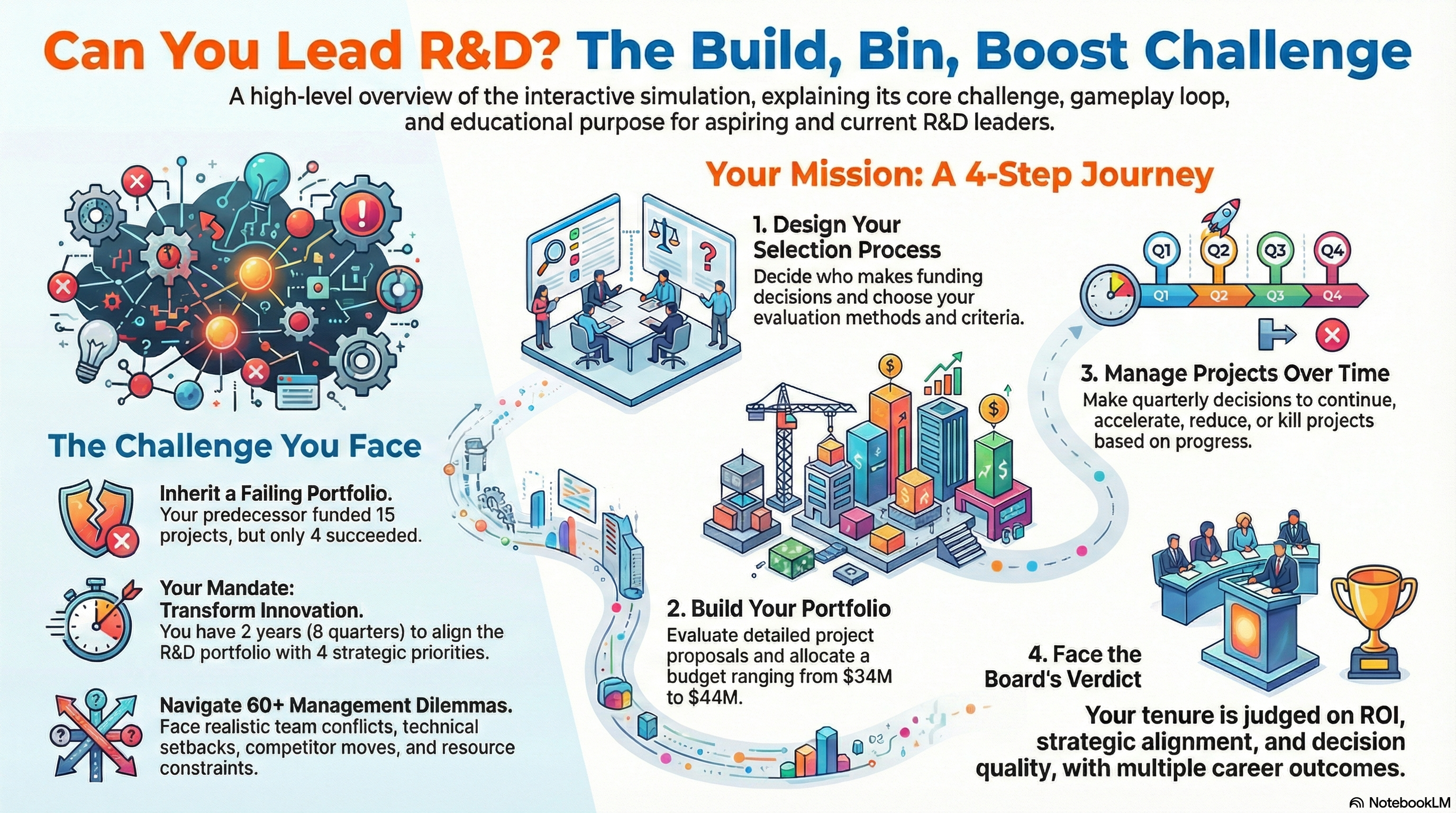
Build, Bin, Boost is an interactive business simulation where players take the role of Head of R&D at ShieldTech India, a fictional home security technology company. Over two simulated years, players must build a portfolio of innovation projects, bin the ones that aren't working, and boost the winners—all while navigating committee politics, budget constraints, and strategic priorities.
The simulation runs entirely in a web browser as a single HTML file. No installation, no accounts, no cost. It is designed for business school teaching and is licensed under Creative Commons for non-commercial educational use.
The Scenario
Your predecessor at ShieldTech India was dismissed after years of poor results—15 projects funded, only 4 successful. The CEO has given you a budget and full authority to redesign how projects are selected and managed.
The board has set four strategic priorities:
Defend Metro Leadership
Retain position in top cities against competitors
Tier 2/3 City Rollout
Profitable entry into emerging cities
Recurring Revenue
Shift from hardware sales to services and subscriptions
AI-First Products
Lead the transition to intelligent security
Meet Devi, the AI Advisor
Devi is the simulation's optional AI advisor. You can switch her on for the whole game or just for project selection, and she will score proposals and offer recommendations. But like real AI tools, she has limits and biases: she overweights what is easy to quantify, projects false precision, and can miss genuinely novel bets. Part of the learning is deciding when to trust her and when to think for yourself.
She is named after Shakuntala Devi (1929–2013), the Indian mathematician and writer renowned for her extraordinary feats of mental calculation.
Research Foundations
The simulation is informed by academic research on:
- R&D project selection — How organisations evaluate and choose which innovation projects to fund
- Decision-making in R&D — The cognitive and organisational factors that shape funding decisions
- Panel dynamics — How selection committees function, including groupthink, advocacy, and consensus-building
- Role tensions — Conflicts between different functional perspectives (technical, commercial, financial, strategic) in project evaluation
- Active portfolio management — The importance of ongoing monitoring, resource reallocation, and project termination decisions
- Strategic alignment — Connecting R&D investments to corporate strategy and balancing short-term delivery with long-term capability building
- AI in project evaluation and selection — The potential benefits and costs of using AI as an assistant in R&D project selection processes
Video Overview
A walkthrough of the simulation covering gameplay, key features, and classroom use.
Podcast
A discussion about the research behind the game and how to use it in teaching.
Why We Built This
Most business simulations are expensive, proprietary, and locked behind commercial licences. We believe high-quality educational tools should be accessible to everyone—students at under-resourced institutions, independent learners, and educators who want to experiment with their teaching.
This simulation was developed as part of ongoing research into innovation management education at Warwick Business School, University of Warwick. It is released under a Creative Commons licence that allows free use, adaptation, and sharing for non-commercial purposes.
Created By
Ammon Salter's research focuses on the management of innovation and technology, with particular interests in corporate R&D, open innovation, university–industry partnerships, and science commercialisation.
Development Assistance
Claude — AI Assistant by Anthropic
GPT-5 — Coding assistance by OpenAI
Gemini — Image generation and project data by Google
License: CC BY-NC-SA 4.0
Contributors
We are grateful to the following colleagues for their feedback and contributions to the development of Build, Bin, Boost:
Playtesting & Feedback
With thanks to the students of the Corporate Entrepreneurship module on the Masters in Management programme at Warwick Business School, who playtested earlier versions of the simulation and offered many valuable suggestions for improvement.