Quick Start
- 1 Open the simulation in a modern browser (Chrome, Firefox, Safari, or Edge)
- 2 No installation or account required — just click Play
- 3 Allow 60–90 minutes for a complete playthrough
- 4 Best played on desktop; functional on tablet
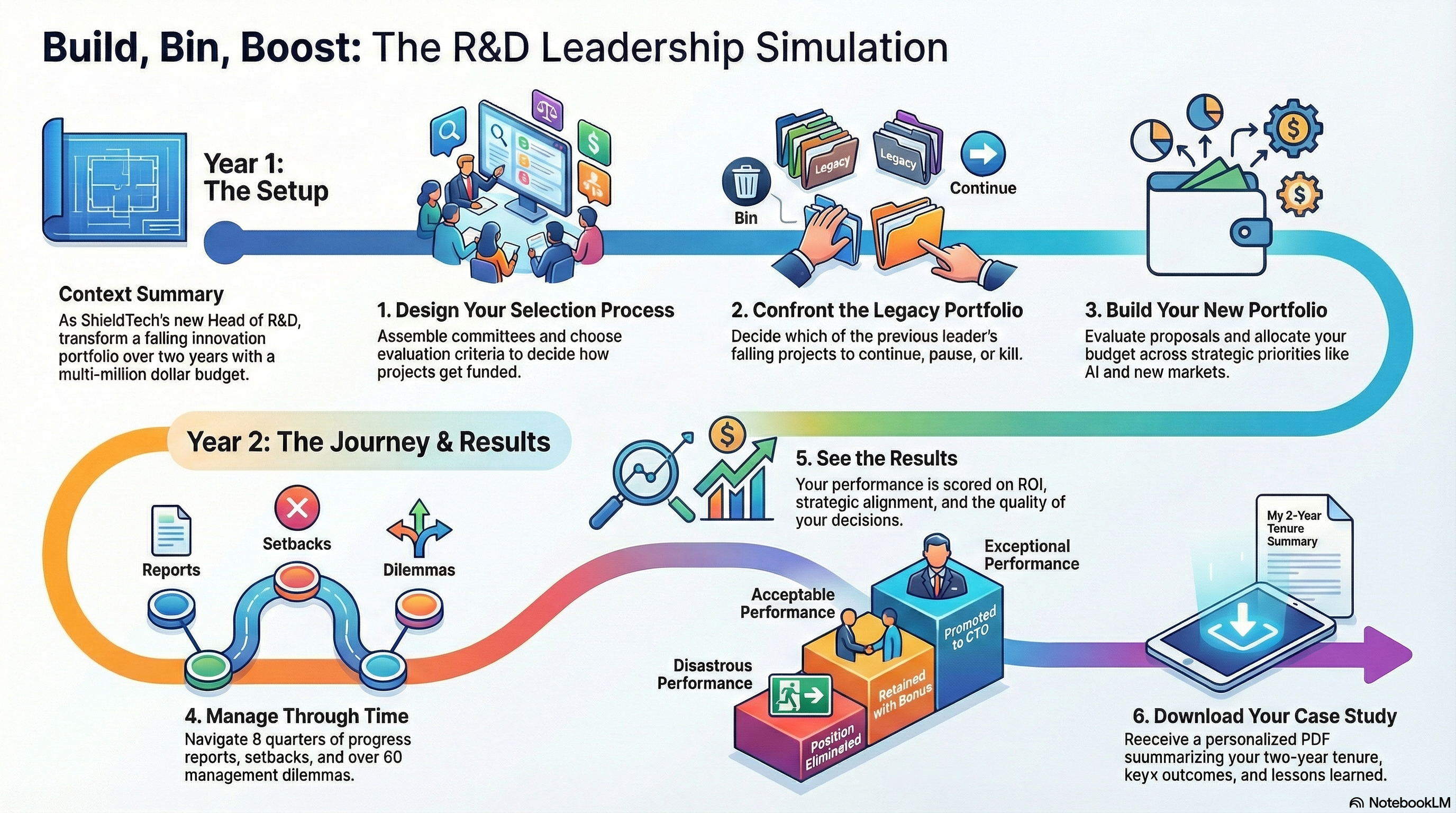
Design Your Selection Process
Choose how project funding decisions will be made. Options include deciding alone, assembling a selection committee, using a staff jury, or random selection. Each approach has trade-offs between speed, expertise, bias, and buy-in. Decide whether to deploy an AI advisor—Devi—across the game or only for project selection.
When forming a committee, you select from ShieldTech's leadership team. Each person brings different expertise, perspectives, and biases—the CTO sees risk differently than the CFO. You also choose evaluation criteria and approaches: structured scoring matrices, intuitive expert judgment, or staged gates.
Handle Legacy Projects
The previous R&D leader left behind ongoing projects in various states. Review each project's history, spending, progress, and political context, then decide whether to continue, pause, or kill. Past spending is sunk—but stakeholder relationships complicate decisions.
Committee Dynamics Mini-Game
Chair a budget committee meeting where you must secure funding for new projects. Committee members debate, advocate, and react to how you facilitate the meeting. Your performance determines the budget available—ranging from $34M to $44M.
Build Your Portfolio
Evaluate 10–12 project proposals. Each comes with rich information: project overview, development milestones, team profiles, technology readiness level, IP position, competitor analysis, financial projections, and risk assessment.
Categorise projects as Fund, Consider, or Stop, then build a portfolio within budget constraints using matrix visualisations to assess balance across risk levels and strategic priorities. Each proposal is tagged with the strategic priority it serves, so you can see at a glance how your portfolio maps to the board's four goals.
Manage Through Time
The simulation runs for 8 quarters (2 years). Each quarter you review progress reports, respond to management dilemmas, and make portfolio decisions—continue, accelerate, reduce, or kill each project.
Over 60 scenarios involving team conflicts, technical setbacks, competitive threats, resource constraints, and stakeholder pressures. Watch the status signals: a project burning budget faster than it makes progress turns amber, then red. Kill a project early and you recover the budget for its unrun quarters to redeploy into new opportunities.
Year 2 Opportunities
At the end of Year 1, new project opportunities emerge. Before evaluating them, you can optionally play the Resource Run mini-game—a logistics challenge that can provide bonus budget for Year 2. A mid-term review also adds funding, and any unspent or freed-up budget lets you fast-track new projects in the quarters that follow.
See the Results
Each project's outcome arrives the quarter after it completes, bringing revenue and market share. The board then evaluates your performance across multiple dimensions: selection accuracy, portfolio returns, market share, risk balance, strategic alignment, portfolio management, active leadership, and how accurate your AI advisor was. Projects still in flight at the end count their expected value. Career outcomes range from Promoted to CTO down to Position Eliminated.
Download Your Case Study
Generate a professional PDF documenting your tenure. Includes an executive summary, portfolio composition, narrative of difficult decisions, detailed scorecard, counterfactual analysis, and lessons learned.
Use this for classroom discussion, reflection assignments, or portfolio building.
Possible Career Outcomes
The board delivers a verdict based on your overall performance:
Playing it too safe is penalised—the board hired an R&D leader to find breakthroughs, not optimise existing products. But reckless risk-taking without discipline also fails.